The master’s degree program in biology is a consecutive course of study building on the biology and molecular biology bachelor’s degree programs at Johannes Gutenberg University Mainz (JGU) or equivalent degree programs at other universities.
Requirements:
Proof of a bachelor’s degree in biology, molecular biology, or an equivalent degree.
Applicants are required to have very good active and passive knowledge of English, enabling them to read specialist literature and participate in courses taught in English; not included is the ability to complete written coursework or examinations in English. No particular proof is required.
If you did not receive your university entrance qualification (Hochschulzugangsberechtigung, HZB) from a German institution or if you completed a degree program where the language of instruction was not German, you must provide proof of your German language proficiency by completing the “German Language Proficiency Examination for Admission to Higher Education for Foreign Applicants.”
Application period:
Winter semester: April 01 – May 15
Summer semester: October 01 to November 15
Application:
Your application is to be submitted through the JGU Mainz Student Service Center.
A degree program comes with many subject-related questions. This page contains all the information on how to structure your degree program, including details about the course structure, modules offered, and detailed module descriptions. Additionally, all necessary forms for registering your project work and your master’s thesis have been compiled here. Do you have further questions and are looking for individual advising? Do you already know our Academic Advisory Office? You can find the responsible advisor’s contact information in the service section of this page.
| Module no. | Subject | Research group |
|---|---|---|
| Module 1 a/b/c (in English) | Protein Bioinformatics and Programming I/II/T | Andrade (Bioinformatics) |
| Module 2a/b/c (in English) | Animal Evolution and Behavioural Ecology I/II/T | Foitzik (Social Evolution) |
| Module 3a/b (in English) | Plant-Animal-Interactions I/II/T | Xu (evol. Plant Science) |
| Module 4a | Humangenetik und Molekulargenetik | Hagemann (Anthropology) |
| Module 4b | Prähistorische Anthropologie | Burger (Palaeogenetics) and Huylmans (Evolutionary Genomics) |
| Module 5a | Evolutionäre Anthropologie | Hagemann (Anthropology) |
| Module 5b-1 | Pharmakogenetik und Populationsgenetik | Hagemann (Anthropology) |
| Module 5b-2 | Bioarchäometrie | Burger (Palaeogenetics) and Huylmans (Evolutionary Genomics) |
| Module 6a/b/c | Tierökologie I/II/T | (Evolutionary Ecology) |
| Module 7a/b/c | Molekulargenetik und Genomanalyse I/II/T | Hankeln (Molecular Genetics) |
| Module 8a/b/c (in English) | Molecular basis of synaptic plasticity I/II/T Molecular basis of synaptic plasticity I/II/T | Heine (Functional Neurobiology) |
| Module 9a/b/c (in English) | Sensory processing / Neurol circuits and tools II/T Sensory processing: neural circuits and tools II/T | Silies (Neural Circuits Lab) |
| Module 10a/b/c (in English) | Molecular Cell Biology I/II/T | Wolfrum (Molecular Cell Biology) |
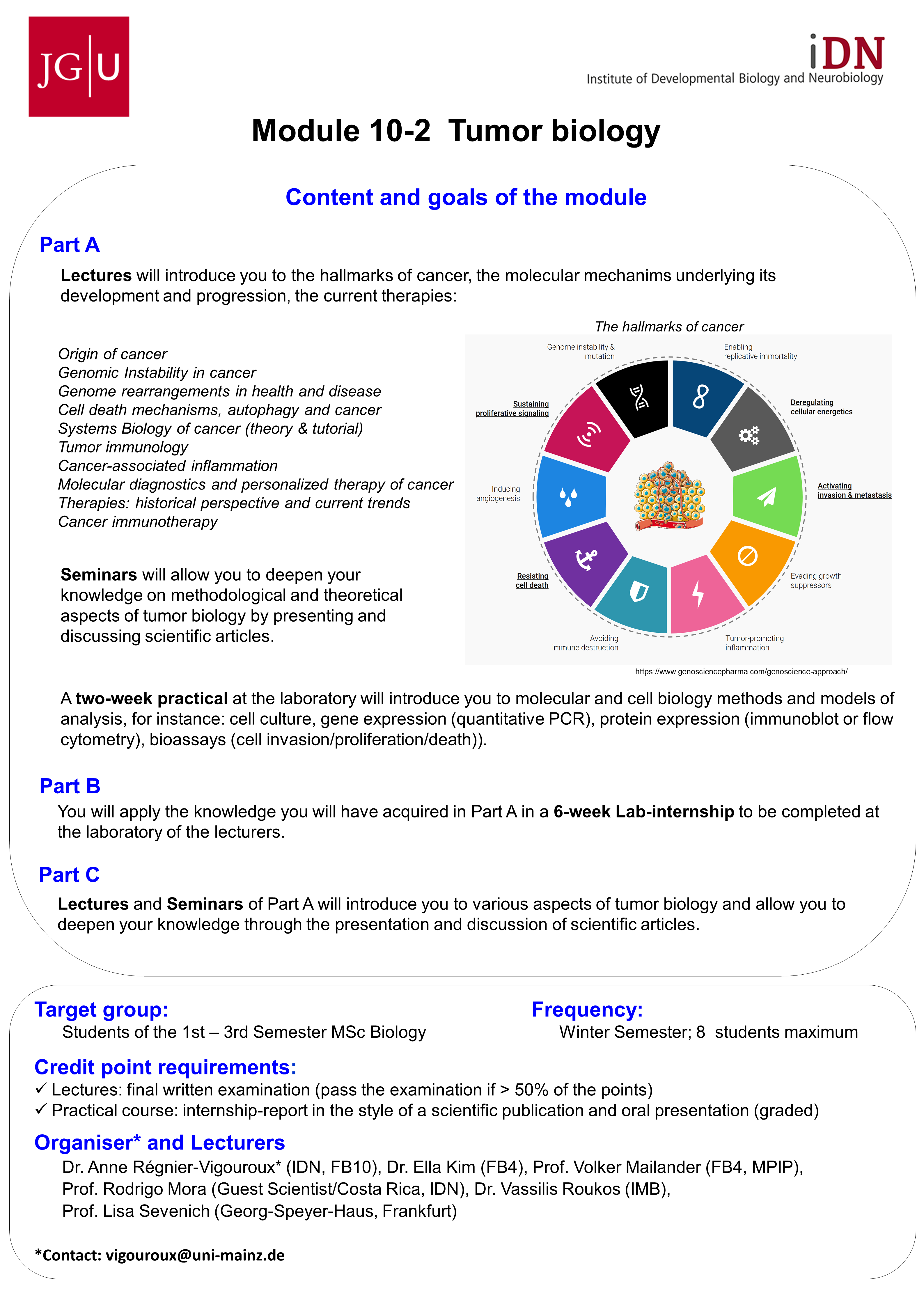
| Module 10-2 a/b/c (in English) | Tumor Biology I/II/T | Régnier-Vigouroux (Tumor Biology) |
| Module 11a/b/c (in English) | Neuronal Basics of Behavior I/II/T | Strauß (Neurobiology I) |
| Module 12a/b/c (in English) | Cellular and molecular Principles of Motor Behavior I/II/T | Duch (Neurobiology II) |
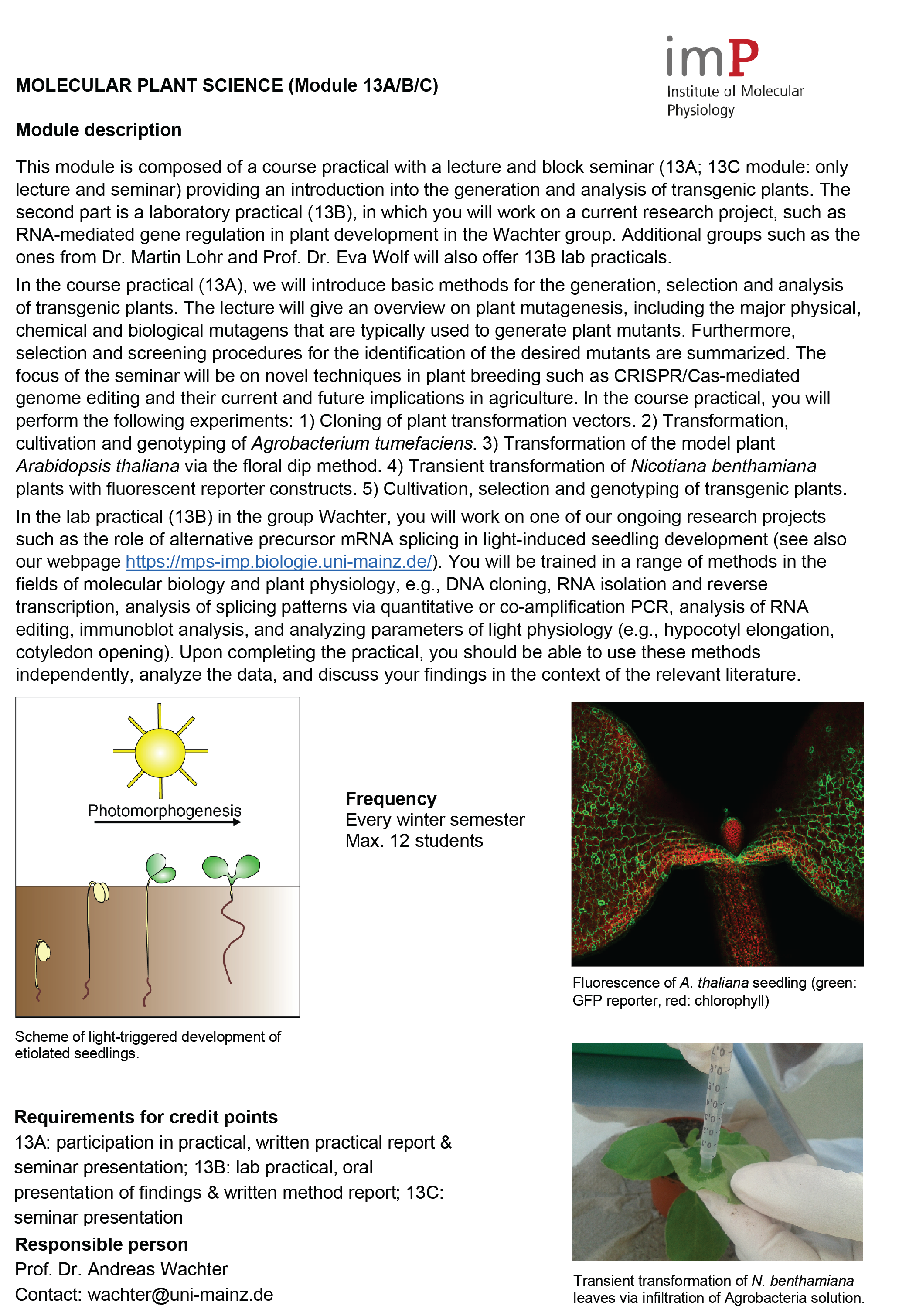
| Module 13a/b/c (in English) | Molecular Plant Science I/II/T | Wachter (Molecular Pflant Sciences) |
| Module 14a/b/c (in English) | Chemical Biology & Molecular Biophysics I/II/T | Lemke (Synthetic Biophysics) |
| Module 15-1 a/b/c (in English) | Biotechnology (Fungual Molecular Physiology) I/II | Thines (Biotechnology) |
| Module 15-2 a/b/c (in English) | Microbiology (a/c: Biomolecular Interactions, b: Bacterial Infection Biology) | Heermann (Microbiology) |
| Module 16a/b/c (in English) | Molecular Biology of Aging I/II/T | Luke (Chromosomal Biology) |
| Module 16-1a/b (in English) | Chromatin Biology & Proteomics I/II/T | Beli (Proteomics) |
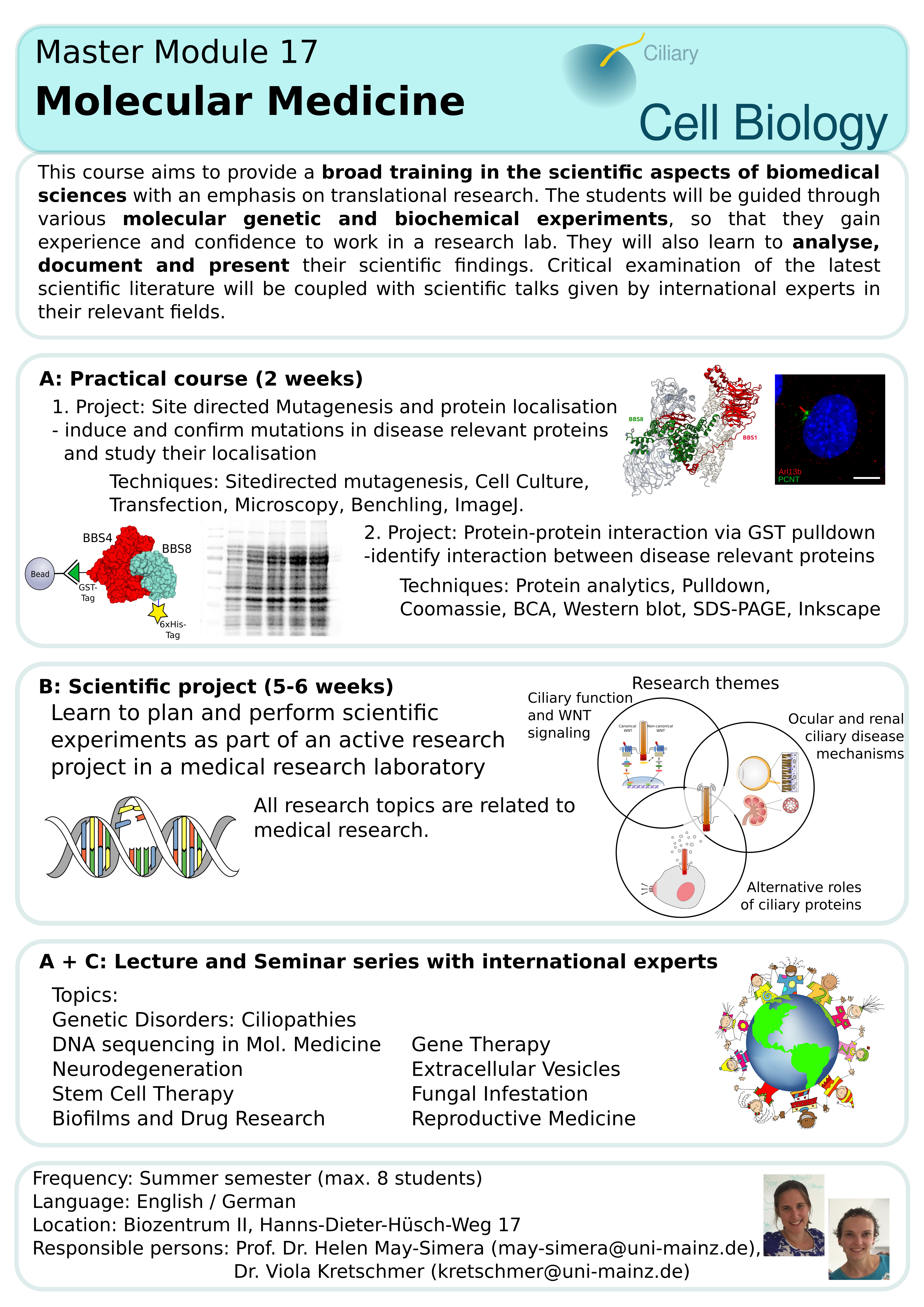
| Module 17a/b/c (in English) | Molecular Medicine I/II/T | May-Simera (Cell Biology) |
Note: Some modules are only offered in the winter semester, some only in the summer semester.
The required elective modules 1 – 17 can be assigned to the main subject areas/specializations as follows:
- Organismic and Molecular Evolutionary Biology: 1 – 7
- Developmental Biology and Neurobiology: 1, 7, 8 – 12, 16 – 17
- Molecular Physiology: 1, 7, 13 – 17
For more information about the organization, content, and required language skills of the various modules, please refer to the relevant module description or the module catalog.
| Module no. | Subject |
|---|---|
| Module EQ | Additional Qualifications |
| Module PA | Project work |
| Module MA | Master’s thesis |
1. Download the registration form (PDF) and save it directly to your device (mobile or computer).
2. Fill in the form using a suitable application (e.g. the free Adobe Reader App available from the App Store or Google Play Store or Acrobat Adobe Reader for desktop devices) and save it to your device.
3. Please also remember to confirm your text entry by clicking on ‘RETURN’ in each line, otherwise your entry may be truncated when you reopen or print the form.
Note: Filling out the form – without downloading – directly in your browser or in browsers on mobile devices is not supported!
Are my entries completely legible or are there any lines that have been cut off? Please check that you have entered everything correctly before sending (!) your application. Thank you!
If that’s the case, all that is missing now are the your signatures, your supervisor’s signature, and – for theses written outside the Faculty of Biology – the faculty representative.
By earning an M.Sc. in Biology, you have acquired the skills for independent scientific work using a modern repertoire of methods from your chosen sub-disciplines. These skills are needed for a doctorate and for numerous occupational fields. You will have professional options on the national and international job market. If you decide to pursue a doctorate, you will also have access to leadership positions in research and the industry. Typical employers are NGOs (e.g., the Society for Nature Conservation and Ornithology [Gesellschaft für Naturschutz und Ornithologie]; German Federation for the Environment and Nature Conservation [BUND]), the pharmaceutical and agricultural industries (intermediate management in each case), publishing houses, and public authorities.
Modern infrastructure for a research-focused life sciences campus: BioCenters I and II are located close to other important pillars of the natural and life sciences in Mainz, such as the Institute of Molecular Biology gGmbH (IMB), the Institute of Pharmaceutical and Biomedical Sciences, the JGU Department of Chemistry, and the Physics Institutes at Mainz University. The two Max Planck Institutes and the Helmholtz Institute Mainz complete the life sciences campus quarter. Short walking distances between all these institutions support close cooperation between the disciplines.
Press and Public Relations staff unit | JGU
Our Student Advising Office is your contact for all questions concerning your studies at the Faculty of Biology. Do you have questions about how to plan your studies and structure your modules? Do you want to register for modules and in JOGUStINe? Are you considering changing your course? We are here to support you!
Appointments at the Dean’s Office, the Student Advising Office, and the Examination Office can be arranged by telephone or email during service hours. Please note that appointments can only be arranged for matters that cannot be settled by telephone, mail, or email. Appointments by prior arrangement only.
Subject-Specific Academic Advice and Studies Manager
Studies Manager
Would you like to have certificates and courses recognized? Do you have subject-specific questions about your bachelor’s program at FB10? Our academic advisors can advise you in the following matters:
Academic Advisory Office
Responsible Person | Recognitions
Bachelor of Education in Biology (B.Ed.)
Bachelor of Science in Biology (B.Sc.)
Bachelor of Science in Molecular Biology (B.Sc.)
Examination Office | Course Manager
Do you have subject-specific questions about your master’s degree program at the Faculty of Biology? Our academic advisors can advise you in the following matters:
Academic Advisory Office
Examination Office | Course Manager
Course Representative | Recognitions
Master of Education in Biology (M.Ed.)
Master of Science in Biology (M.Sc.)
Master of Science in Evolutionary Biology (M.Sc.)
Course Representative | Recognitions
Master of Science in Microbiology (M.Sc.)
Master of Science in Molecular Biotechnology (M.Sc.)
Master of Science in Neuroscience (M.Sc.)
The course representative for your bachelor’s or master’s program at the Faculty of Biology is responsible for the recognition of coursework. He or she makes a recommendation which the Examination Office usually follows and then formally recognizes and records in your JOGU-StINe account.
If you would like to have coursework recognized, please note the instructions on the following page. You can also download the ‘Äquivalenzbescheinigung’ (certificate of equivalence) form here.
Do you have subject-specific questions about your distance learning program or pre-university program at the Faculty of Biology? Our academic advisors provide advice on the following topics:
“Distance Learning” Biology
“Pre-university Program” Biology
Appointments at the Dean’s Office, the Student Advising Office, and the Examination Office can be arranged by telephone or email during service hours. Please note that appointments can only be arranged for matters that cannot be settled by telephone, mail, or email. Appointments by prior arrangement only.
Head
Second-level support
You will find all important contacts for our international activities in the following overview:
JGU International | Erasmus+
All the information about the Erasmus+ program can be found on the JGU International webpage.
Erasmus+ Coordinator
There is an annual online information event via MS Teams. The dial-in code for the event and the date (usually early/mid-January) will be sent via a system message in JOGUStine. If you are interested, please register for the event in JOGUStine. A checklist and deadlines, e.g. application deadline for the respective academic year, will be announced in mid-February via the relevant Moodle Faculty of Biology Erasmus+ info event.
Ombudsperson for foreign students
JGU International | FORTHEM
Information about FORTHEM can be found on the JGU International webpage.
Partner Cities Representatives
Dijon
Palermo
Valencia
Zagreb
Haifa
Are you enrolled in a degree program at the Faculty of Biology that is currently being discontinued? In this section you will find the relevant information. Please note that new applications for these degree programs are no longer possible!
“Diplom Biologie”
Anthropology (M.Sc.)
The Student Council Biology represents my interests during my studies, provides me with information and advice, and invites me to events. Curious about getting involved or would you like more information?
Student Council Biology of
Johannes Gutenberg University Mainz
The library of the faculty is part of the Mathematics, Computer Science, Natural Sciences and Technology Library (MIN).
Mathematics, Computer Science, Natural Sciences, and Technology Library
Student Services is your first contact point for advising you on general questions relating to applications and the program of study at Johannes Gutenberg University Mainz (JGU). Please visit the program of study portal for further information during service hours.
There are many questions related to a program of study. The Student Advisory Center (ZSB) is the first point of contact at JGU for all questions relating to the program of study. You can find all information on office hours and advisory services on the ZSB website on the “Studying at JGU” website.
On the Studying at JGU portal, you can find information on funding options for your studies and the various scholarship options, including a Deutschlandstipendium, a scholarship for gifted students, target group-oriented or earmarked scholarships.